Sissu in Winter 2026–27: Road Status, Snow Odds, Closures
Sissu in winter, month by month for 2026–27. Ten winters of model snow estimates for the Atal Tunnel road, the Halda festival curbs that suspend tourism in Sissu from mid-January, the e-pass, SADA fee and green tax, and how a group from Delhi should plan the Sissu day.


In this guide
- 01Can a 4-day trip from Delhi reach Sissu this winter?
- 02January to March: when Sissu gets hard to reach
- 03The odds your Sissu day lands after a big snowfall
- 04What actually shuts the road: the climb above Solang
- 05How a snow closure plays out
- 06The Halda curbs: Sissu suspends tourism from mid-January
- 07Permits, fees and rules for the Sissu run
- 08How a group should plan the Sissu day
- 09Day trip from Manali or a night in Sissu?
- 10Is Sissu in winter OK for families and older travellers?
- 11If the road to Sissu is shut
- 12How cold is Sissu in winter, and what to pack
- 13Frequently asked questions
- 15 min to go
Sissu in winter is reachable more often than its reputation suggests, but not all winter. The Atal Tunnel road is usually open in November and most of December, Sissu's panchayat has suspended tourism from mid-January to 28 February three years running, and January brings the most heavy-snow days.
Can you visit Sissu in winter 2026–27?
Usually yes in November and December. In ten winters of model snow estimates, only 10–15% of November and December days were a 20 cm snow day at the tunnel's south portal or one of the two days after. From 1 January those odds roughly double or triple, and since 2024 Sissu has suspended tourism from mid-January to 28 February.
The short answer
November and most of December: the road to Sissu is open on most days, with 10–15% heavy-snow odds.
From 1 January the odds rise two- to threefold, and from mid-January Sissu suspends tourism until 28 February.
After snow, cars stop at Nehru Kund or Solang Nala and 4x4s go through first; closures have lasted up to 24 days.
Put Sissu on day 2, agree a Plan B before you leave, and keep cash for delays.
Can a 4-day trip from Delhi reach Sissu this winter?
Yes in November and most of December; less reliably after that. A 4-day trip from Delhi has one planned day for Sissu, plus a fallback day if you plan it yourself; the question is whether it lands on an open road.
November: fewest big snow days, no crowds
Sissu got some snow in all ten Novembers in our data, but November had the fewest heavy-snow days at the south portal, with no festival curbs or holiday crowds. Only 12–15% of November days were a 20 cm snow day at the south portal or one of the two after.
1–24 December: good odds, colder
The odds stay around 10–15% until Christmas. Model estimates put days around freezing and nights at about −11 °C: snow at the roadside without January's closures. The holiday crowds arrive in the last week, so the first three weeks are the calmest time to go.
Christmas to New Year: crowds meet snow
In December 2024, more than 1,000 vehicles were stuck between Solang Nala and the tunnel (reported 24 December); on 28 December about 2,000 were stranded at Solang and over 10,000 tourists evacuated. Leave early; turn back at the first warning.
January to March: when Sissu gets hard to reach
After New Year, a 4-day trip needs more slack. The snow odds jump, Sissu's festival curbs begin in mid-January, and early March still brings storms. If January or February is your only window, treat Solang as the snow day and Sissu as a bonus.
1–15 January: open, but the odds rise two- to threefold
Sissu is still open to tourists in early January, but the snow odds jump from 10% in late December to 32% in the first half of January. Keep two possible Sissu days and a firm Plan B.
Mid-January to 28 February: little to do in Sissu, if you can get there
Most heavy snow falls now, and Sissu suspends tourism for its festivals (below). Plan around Solang, not Sissu: when the road is open up to Solang Nala, its slopes have snow and the paid activities, and you lose nothing if the tunnel road stays shut.
March: open again, still snowy
Sissu's festival curbs have ended on 28 February each year, but early March still gets big storms. On 15 March 2026, snow near the tunnel trapped tourist traffic and more than 1,500 vehicles were evacuated towards Manali.

Escapes to Sissu & Manali
The odds your Sissu day lands after a big snowfall
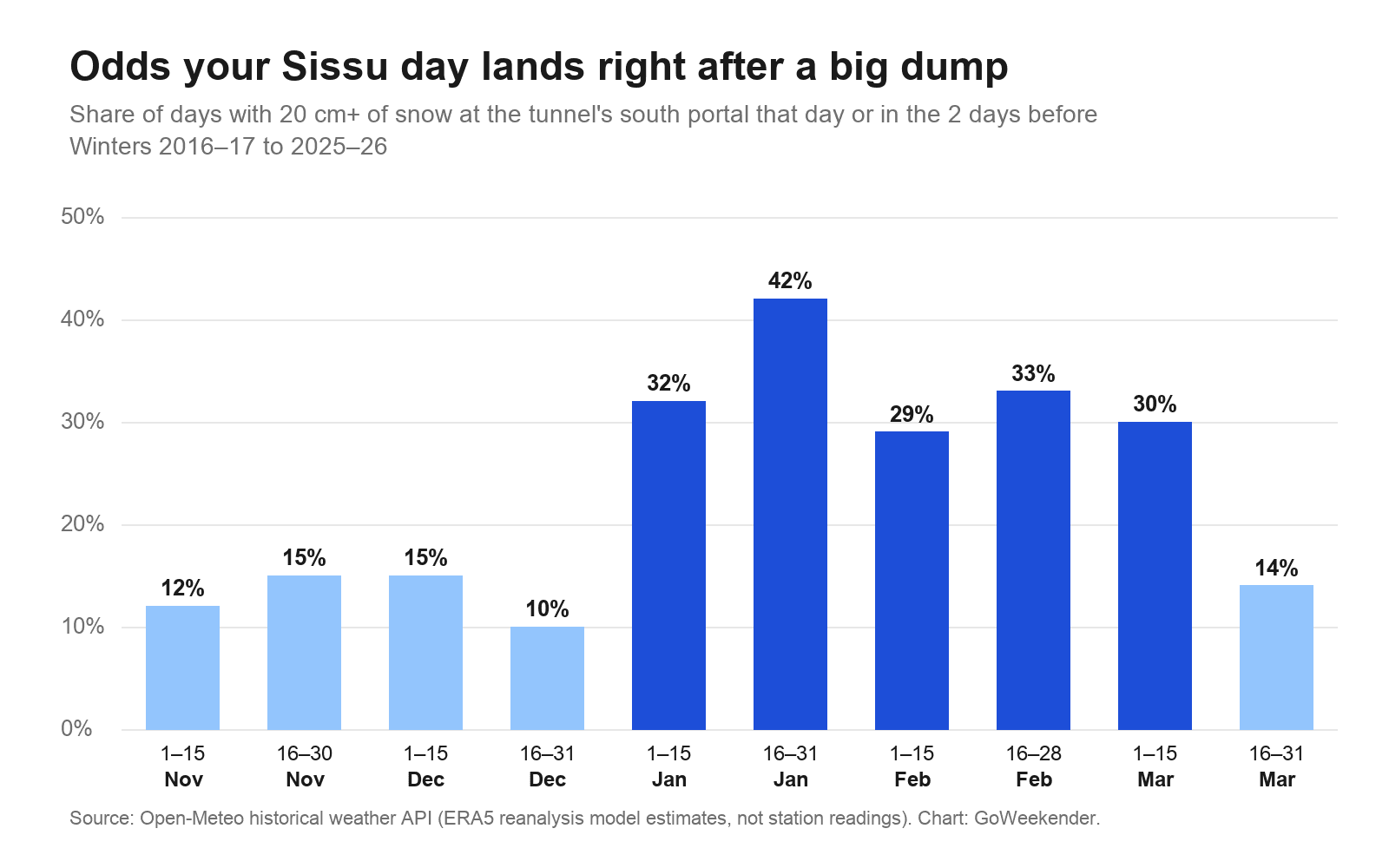
Your chances drop sharply from 1 January. Using ten winters of daily model data, we counted how often a given day was a day with 20 cm or more of new snow at the tunnel's south portal, or one of the two days after it. Real closures can run far longer than three days (about two weeks in 2026), so the January and February figures understate the risk.
1–15 November: 12%
16–30 November: 15%
1–15 December: 15%
16–31 December: 10%
1–15 January: 32%
16–31 January: 42%
1–15 February: 29%
16–28 February: 33%
1–15 March: 30%
16–31 March: 14%
A big dump doesn't always mean a closure, and roads can shut without one (ice, a warning, crowds). Treat these as the odds of trouble, not a forecast. These are model estimates from ERA5, a global weather reanalysis whose grid cells are roughly 10–30 km wide, adjusted here for each point's altitude. They show the pattern, not exact totals at any one bend of the road. For your dates, check the forecast a week out and again the night before.
What actually shuts the road: the climb above Solang
Most closures start on the Manali side, not at Sissu, though heavy snow can cut the Lahaul side too: in late January 2026, connectivity between Manali and Lahaul was suspended completely. Sissu sits about 40 km from Manali by road. The first 13 km to Solang are low and usually clear, and the next 12 km climb to the tunnel's south portal at 3,060 m, where the model puts the most heavy snow.
Manali to Solang: about 13 km
Manali to the south portal: 25 km, at 3,060 m (PIB factsheet)
The tunnel: 9.02 km long, opened on 3 October 2020
The north portal: near Teling, Sissu, at 3,071 m
Manali to Sissu: about 40 km (OpenStreetMap routing)
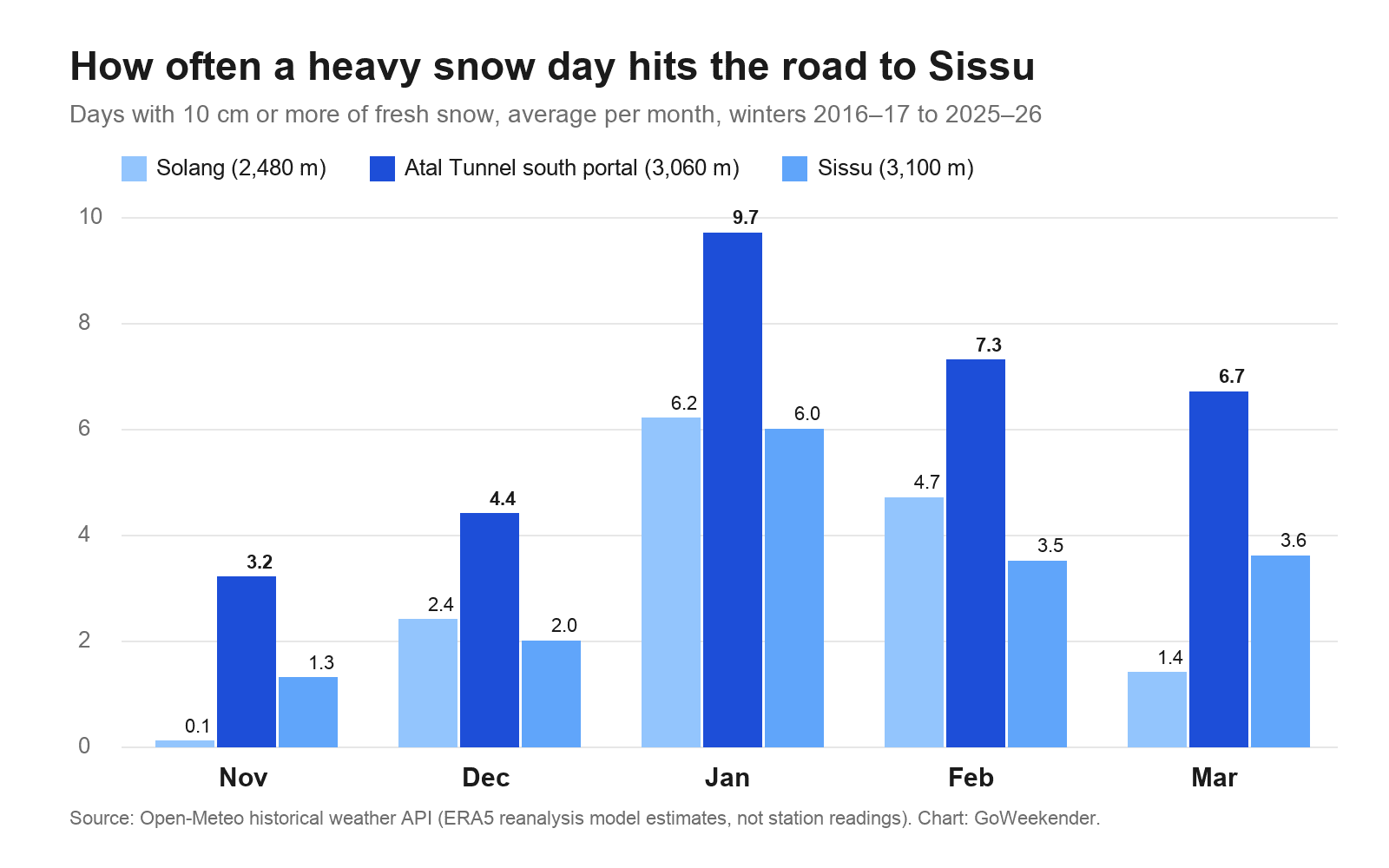
In January, the south portal averaged 9.7 days a month with 10 cm or more of fresh snow, against 6.0 at Sissu and 6.2 at Solang. The tunnel takes you under the worst of it, but the climb to its entrance is where cars get stuck.
How a snow closure plays out
After heavy snow, the police close the road in stages from the top down, then reopen it from the bottom up. Recent closures have followed a similar pattern:
On a snowfall warning: tourist vehicles were stopped at Solang Nala (27–28 December 2024).
During and after heavy snow: traffic stops at Nehru Kund, just above Manali, or at Palchan (December 2024, January 2026 and March 2026).
Reopening: first emergency vehicles, then tourists in 4x4s only beyond Solang Nala (February 2026). In March 2026, cars stopped at Nehru Kund and only 4x4s could go on to Solang Nala.
Extra conditions: in January 2021, after a 24-day closure, tourists could go beyond Solang only until 1 pm, were told to be back by 4 pm, and could go past Sissu only with a hotel booking and a 4x4 (The Tribune).
Closures last from a day or two to several weeks. In 2026, the festival order had already stopped vehicles towards Sissu from 14 January when snow on 23–24 January blocked the tunnel for nearly four days; fresh snow on 27 January halted traffic at Palchan again, and The Tribune reported on 9 February that tourists had been let back beyond Solang "two days ago", in 4x4s only. Snow alone kept tourists out for about two weeks.

The Halda curbs: Sissu suspends tourism from mid-January
Sissu's panchayat has suspended tourism for about six weeks each of the last three winters, for village deity rituals and the Halda festival (and in 2026, Poonha). Stalls, snow activities and adventure sports stop. The panchayat announces the dates each January, so treat 2027 as likely but unconfirmed.
2024: 15 January to 28 February (The Tribune)
2025: 15 January to 28 February, including the Sissu helipad (The Tribune)
2026: 20 January to 28 February, from Pagal Nullah to Ropsang, with ATVs, skiing, zip-lining and other activities barred (The Tribune)
In 2026 it went further than a tourism ban. The SDM Keylong restricted vehicles of all categories "from Kuthbihal towards Koksar and Sissu" from 14 January "until further orders", with only emergency, police and BRO vehicles exempt (The Tribune). By 9 February, The Tribune reported tourists in 4x4s heading through the tunnel to "popular destinations such as Sissu", so the road reopened before the village's tourism ban ended on 28 February. You may reach Sissu in late February, but expect nothing running there.
Permits, fees and rules for the Sissu run
A self-drive group pays these at the barriers; on a hosted trip, check whether the price includes them. Check each one before you leave, because none of these portals shows a date.
e-Aagman pass: the HP e-Aagman portal says vehicles entering Lahaul and Spiti must apply for an e-pass, with an "E-Permit per vehicle" for the Atal Tunnel–Koksar–Chandratal circuit and an "E-Ticket per vehicle" for other places. The portal doesn't say which one a Manali-to-Sissu day needs, so apply for the option it offers for your route before you drive up. On a hosted trip the host applies; the Manali, Sissu & Kasol Getaway lists all permits as included.
SADA fee at Teling, Sissu: ₹50 for a motorbike, ₹200 for a car, ₹300 for an SUV and up to ₹500 for a bus; Himachal-registered vehicles don't pay (Outlook, rates as of September 2021; we found no newer rate card).
Manali green tax: ₹100 for a bike, ₹200 for a car and ₹300 for a passenger vehicle not registered in Himachal, valid seven days (Kullu district portal, checked 3 Nov 2026).
North Portal: since 4 April 2026, no stopping, parking or gathering on the avalanche-prone slopes and around the Chandra bridge (The Tribune). Take your photos in Sissu, not at the portal.
How a group should plan the Sissu day
Put Sissu on day 2, keep a Plan B, and agree on both before anyone boards the overnight bus or tempo traveller from Delhi to Manali. Deciding at the barrier wastes the morning.
Day 2, not day 4: planning your own trip, put Sissu early so a closed road on day 2 leaves day 3 to try again. On a hosted trip the days are fixed, so ask the host before booking what happens to a missed Sissu day.
Leave Manali by 9 am: reopenings have come with afternoon cut-offs, and the light goes early.
Check that morning: read the latest notices from the Kullu and Lahaul-Spiti district administrations and police, and ask your driver or host; drivers usually hear about a closure at Solang before it reaches any website. In an emergency, dial 112.
Driving yourself: if nobody in the group has driven on snow, hire a local driver. Carry chains, and don't set off in the early morning after fresh snow, when the road is iciest.
Know who pays for delays: a hosted trip may not cover it. The Manali, Sissu & Kasol Getaway lists costs from road blockages and landslides as borne by the traveller, so keep some cash in the group kitty.
4x4 only means a different car: if the police allow only 4x4s beyond Solang, a tempo traveller can't go. A local 4x4 taxi is the fix. We found no official rate card, so get that day's rate from the taxi stand and split it before you hire: if a vehicle costs ₹5,000 for the day (an example, not a quote), four people pay ₹1,250 each and five pay ₹1,000.
New to group trips? Our guide to finding travel buddies in Delhi covers how to vet a crew before a winter trip like this.
Day trip from Manali or a night in Sissu?
For a 4-day trip from Delhi, do Sissu as a day trip from Manali. The hosted Manali, Sissu & Kasol Getaway works this way: it travels overnight from Delhi, reaches Manali in the morning, and spends day 2 on Solang, the tunnel and Sissu before returning to Manali for the night.
A night in Sissu suits a longer trip with flexible dates. If snow shuts the climb behind you, you wait in Sissu until it reopens, so only stay over with spare days. Confirm the stay is open and heated before you book. After the 24-day closure in January 2021, only tourists with a hotel booking could go past Sissu, so carry your booking.
At Sissu itself, most people walk to the riverbank of the Chandra, look across at the waterfall on the far side and spend an hour in the snow. In winter there is little else to do, which is why a day is enough.
Is Sissu in winter OK for families and older travellers?
Yes for a day trip, with care. Sissu is at about 3,100 m, high enough for headaches and breathlessness in some people, and the cold is hard on small children and older travellers. A long jam makes both worse: in December 2024 and March 2026, people sat in stranded cars for hours. Carry water, food, medicines and warm layers in the car, and turn back early if the weather turns.
If the road to Sissu is shut
Swap the day, don't wait at a barrier. If tourists are stopped at Solang Nala, Solang itself still has snow and the activities the trip lists (zorbing, ATV rides, skiing, paragliding, all paid on the spot). If they are stopped at Nehru Kund, stay in Manali for Hadimba Temple and Old Manali, and move on early towards Kasol.
The Parvati Valley sits much lower than the tunnel, so a Kasol night makes a good back-up. Our Kasol in December guide has the snow odds there, and the Kasol 3-day itinerary has the bus and road timings.

How cold is Sissu in winter, and what to pack
About 10–13 °C colder than Manali, by model estimates: in December the model puts Manali at about 10 °C by day and 2 °C at night. Model estimates for Sissu over ten winters put November at about 4 °C by day and −7 °C at night. From December to February, days hover just below freezing and nights average around −11 to −12 °C, with the coldest nights near −25 °C.
Treat those numbers as a guide: weather models can run cold in steep valleys. Pack for −15 °C anyway, because you'll be standing in the snow for hours.
Layers: a thermal base, a fleece and a down or padded jacket
Feet: waterproof shoes with grip and two pairs of wool socks
Hands and head: gloves, a woollen cap and a buff
Eyes and skin: sunglasses for snow glare, sunscreen and lip balm
For the road: water, snacks and any medicines, in case you sit in a jam for hours

Frequently asked questions
Is Atal Tunnel open in winter?
On most November and December days, yes. When it shuts, it's usually because of snow on the climb above Solang, not inside the tunnel, though heavy snow can also block the Lahaul side. After heavy snow, the police stop tourist cars at Nehru Kund or Solang Nala and later let 4x4s through first. Closures have lasted from a day or two to 24 days in January 2021, and in 2026 a festival order stopped vehicles towards Sissu from 14 January.
Is Sissu open for tourists in January 2027?
Probably only in the first half, and with more snow risk than December. Sissu's panchayat suspended tourism from 15 January to 28 February in 2024 and 2025, and from 20 January in 2026, when an SDM order also stopped vehicles heading to Sissu from 14 January. In early January the snow odds are two to three times December's.
Can we visit Sissu in December?
Yes, most December days. In ten winters of model snow estimates (ERA5 via Open-Meteo), only 10–15% of December days were a 20 cm snow day at the tunnel's south portal or one of the two days after. Late December brings the crowds: in December 2024, thousands of vehicles were stranded at Solang after snow.
What is the best month to see snow in Sissu without closures?
November or the first half of December. Snow is likely by December (in November it can be patchy), the road is open on most days, and the village hasn't suspended tourism for its winter festivals yet. Expect daytime highs near freezing in December.
Do I need a permit for Sissu?
As of November 2026, the HP e-Aagman portal says vehicles entering Lahaul and Spiti need an e-pass. Cars not registered in Himachal also pay the Manali green tax (₹200 for a car as of November 2026) and the SADA fee at the Teling barrier near Sissu (₹200 for a car, the last published rate, from September 2021). On a hosted trip, check whether the price includes them.
Is a 4x4 compulsory for Sissu in winter?
Not always, but often after fresh snow. In February 2026, the police let only 4x4s beyond Solang Nala after a big snowfall, and in March 2026 only 4x4s could even go up to Solang Nala. A tempo traveller or a hatchback gets turned back then, so groups hire a local 4x4 taxi.
How far is Sissu from Manali?
About 40 km by road through the Atal Tunnel. The south portal is 25 km from Manali and the tunnel is 9.02 km long, with its north portal near Teling, Sissu. Allow about 2 hours in clear weather (the hosted Manali, Sissu & Kasol Getaway schedules 9 to 11 am), and far longer after snow.
How cold does Sissu get in winter?
Very. Model estimates for Sissu put December-to-February nights around −11 to −12 °C on average and the coldest nights near −25 °C, with daytime highs just below freezing. November is milder, at about 4 °C by day and −7 °C at night.
Can we stop at the Atal Tunnel North Portal for photos?
Plan not to. On 4 April 2026, the Lahaul-Spiti administration banned stopping, parking and gathering on the slopes around the north portal and the Chandra bridge because of avalanche risk, until a hazard reassessment. We found no notice lifting it as of 3 November 2026, so take photos in Sissu instead.
What if the road to Sissu is closed on our trip?
Swap the day rather than wait at a barrier. If tourists are stopped at Solang Nala, Solang still has snow and activities. If they are stopped at Nehru Kund, spend the day in Manali and leave early for Kasol. Agree this Plan B with your group before you travel.
Going to Sissu this winter?
Book a hosted Manali and Sissu trip from Delhi, or meet travellers heading the same way and plan your own winter run.
Get the appGoing with friends? Send it to the group.

Written by
GoWeekender Team
We're the team building GoWeekender, the app that matches verified travellers across India by vibe, budget and pace. We write about what we learn planning group trips.
First published